How to Choose the Right WhatsApp Business API Platforms for Drag-and-Drop Interface
Picking a WhatsApp Business API platform usually starts with a demo, not a workflow test. Some tools look polished until you try building a simple order confirmation without a developer. That gap decides how fast your team ships campaigns and replies.
This article walks through what actually matters in a drag-and-drop builder: flow logic, triggers, integrations, pricing models, and Meta partner status. By the end, you will know which questions to ask before committing, and how Com.bot fits into that evaluation.
Why Drag-and-Drop Matters in a WhatsApp Business API Platform
Businesses adopting WhatsApp Business API often face a critical decision: build automation with developer resources or enable non-technical teams with a visual interface. The traditional path required engineering hours for every flow change, from webhook configuration to message template logic.
Drag-and-drop builders changed that equation. A visual workflow editor lets marketing, support, and operations teams assemble chatbots and campaign flows without touching code. No-code tools can reduce deployment timelines compared with fully custom builds.
Speed matters in conversational commerce, where customer expectations shift quickly. A drag-and-drop interface supports rapid iteration, so a welcome flow or broadcast sequence can be adjusted the same day a problem appears rather than waiting on a sprint cycle.
No-Code Automation vs. Developer-Dependent Builders
The core difference between no-code and developer-dependent builders lies in who controls the automation lifecycle: business users or engineering teams. That single distinction shapes cost, speed, and how flexible a platform stays as your needs evolve.
A no-code builder centers on a drag-and-drop editor with pre-built templates, node-based logic, and a flow builder that anyone on the team can operate. A marketing manager can update a welcome sequence in minutes. Adding an interactive message or adjusting a message template is a matter of dragging a block and saving.
A developer-dependent approach works differently. It relies on direct API integration, webhook configuration, and custom code for routing, session messaging, and data handling. The same welcome flow change might take a developer days of writing, testing, and deploying API calls.
Each model carries trade-offs worth weighing before platform selection:
- No-code strengths: faster launches, lower dependency on engineering, easier handoffs between teams, and quick experimentation with broadcast or session messaging.
- No-code limits: complex conditional logic, unusual CRM integration, or heavy data transformation may exceed what a visual editor handles cleanly.
- Developer strengths: full control over custom logic, deeper helpdesk software or e-commerce platform connections, and fine-grained performance tuning.
- Developer costs: slower iteration, higher reliance on scarce technical staff, and bottlenecks when business teams need urgent changes.
Experts recommend assessing two things before choosing: your team's technical capacity and your long-term flexibility needs. If most changes come from marketing or support, a drag-and-drop interface keeps momentum in their hands. If your automation depends on intricate logic or deep system integration, a developer-first platform may serve you better, or you may want a tool that offers both paths.
Many teams land in the middle. They start with a no-code builder for everyday flows, then bring in developers only for edge cases. That hybrid approach preserves speed for routine work while keeping room for customization when workflow automation demands it.
Core Features to Evaluate in a Visual Bot Builder
Not all visual bot builders are created equal; the depth of flow logic, template libraries, and iteration speed can make or break your automation strategy.
When comparing WhatsApp Business API platforms, look beyond surface-level drag-and-drop appeal. The strongest no-code builders handle complex customer journeys without forcing you into custom code.
Five criteria matter most: flow logic, trigger variety, conditional branching, template depth, and how quickly you can revise a live flow. These separate a visual workflow editor that scales from one that stalls.
Flow Logic, Triggers, and Conditional Branching
A visual bot builder's power is measured by its ability to handle real-world conversation complexities through intuitive flow logic and conditional branching.
Start with the building blocks. A capable drag-and-drop editor should offer nodes for sending messages, adding delays, calling webhooks, and triggering actions like tagging a contact or updating a CRM record. If you cannot place these as separate nodes, your automation will hit a wall fast.
Triggers deserve equal scrutiny. Look for support across:
- Keyword triggers that fire when a user sends a specific word or phrase
- Action-based triggers tied to button taps, list selections, or link clicks
- Time-based triggers for follow-ups, reminders, or re-engagement windows
- Webhook triggers that respond to events from your e-commerce platform or helpdesk software
Conditional branching is where real personalization lives. A lead qualification bot, for example, might ask about budget and timeline, then route hot leads to a sales rep while sending others to a nurture sequence. An order status bot can branch based on delivery stage, showing different messages for packed, shipped, or delivered states.
Be cautious with builders that only support linear flows. They cannot handle the if/else logic that conversational commerce demands. Also check for built-in testing and debugging tools. A simulator that lets you walk through a flow before publishing saves hours of trial and error.
Template Library and Ease of Iteration
A rich template library and seamless iteration capabilities can slash the time from idea to live automation.
Pre-built templates for common use cases accelerate deployment significantly. Look for starters covering welcome messages, order confirmations, FAQs, appointment reminders, and abandoned cart follow-ups. These give you a working foundation instead of a blank canvas.
Equally important is what you can do after selecting a template. The best chatbot builders let you clone, edit, and A/B test flows without rebuilding from scratch. Version control and rollback features matter too. If an update underperforms, you should be able to restore the previous flow in a few clicks.
Consider a practical scenario. Your marketing team wants to swap a promotional message across every active flow. With a well-designed flow builder, that change takes minutes through a shared node or global variable. With a weaker tool, someone edits each flow manually and risks inconsistency.
This is where drag-and-drop editors earn their keep. Non-technical team members can adjust copy, reorder steps, and test variations daily without filing a development ticket. That rhythm of continuous improvement is what keeps customer engagement fresh and responsive to real conversation data.
Integration and Scalability Checklist
Your WhatsApp automation must connect seamlessly with your existing tech stack and scale as your message volume grows. A drag-and-drop interface makes workflow building simple, but the platform underneath has to move data in and out of your other tools without friction.
Before committing to any WhatsApp Business API provider, review two areas: integration depth and volume capacity. These determine whether your chatbot development stays useful as your customer base expands.
CRM, Ecommerce, and Payment Connections
Out-of-the-box integrations with CRM, e-commerce, and payment systems turn WhatsApp from a messaging channel into a revenue-driving engine. Look for connectors that cover the tools your team already uses daily.
- CRM: Salesforce, HubSpot, Zoho
- E-commerce: Shopify, WooCommerce, Magento
- Payments: Stripe, Razorpay, PayPal
These connections power practical use cases. A CRM link can trigger a welcome message when a lead is created. An e-commerce sync supports abandoned cart recovery and order tracking. A payment gateway enables in-chat transactions, which shortens the path from conversation to purchase.
Check whether the platform offers native connectors or relies on Zapier-style workarounds. Native integrations tend to be more stable and require less maintenance. For anything custom, confirm that webhook configuration is supported so your developers can build tailored flows.
Use this quick checklist during platform selection:
- Does it offer two-way sync, or only one-way data pushes?
- Can it trigger messages based on CRM events?
- Are webhooks available for custom API integration?
Two-way sync matters most. Without it, your CRM and your WhatsApp conversations drift out of alignment, and agents lose context. Confirm these details before you test the drag-and-drop editor, since a polished interface cannot compensate for shallow integrations.
Handling Bulk Messaging and Order Updates at Volume
Scaling from hundreds to millions of messages requires infrastructure that maintains deliverability, speed, and compliance. A visual workflow editor may look identical across platforms, but the engine behind it varies widely.
Ask about three technical requirements: rate limits, message queuing, and delivery reports. Rate limits cap how many messages leave per second. Queuing prevents loss during traffic spikes. Delivery reports confirm what actually reached the customer.
Ask your provider about throughput capacity rather than assuming it.
Understand the difference between message types for broadcasts:
- Session messages apply within an open customer service window and suit live conversations.
- Template messages are pre-approved and required for bulk sends outside that window.
Opt-in management and compliance are not optional. Sending promotional content without consent risks your number being banned, which halts every workflow you built.
Consider a realistic example: a flash sale that needs order updates sent to a large customer list within minutes. The platform must queue those sends, respect template rules, and report delivery status in real time. If any piece fails, customers receive late or duplicate notifications, and trust erodes quickly.
Pricing Models and Hidden Costs to Compare
The total cost of a WhatsApp Business API platform extends far beyond the sticker price; understanding pricing models is crucial to avoid budget surprises. Two structures dominate the market: per-conversation markups and flat subscription plans.
Both can work well, but they reward very different usage patterns. A platform that looks cheap at first glance may carry add-on fees, setup charges, or overage penalties that only surface once your chatbot development scales.
Before comparing vendors, map your expected monthly conversation volume and the features your drag-and-drop interface will actually use. That baseline makes the trade-offs below far easier to judge.
Per-Conversation Markups vs. Flat Subscription Plans
Choosing between per-conversation markups and flat subscription plans hinges on your expected message volume and budget predictability. With a markup model, the platform adds a small fee on top of each conversation, which suits low-volume pilots but grows costly at scale.
Flat subscription plans charge a predictable monthly or quarterly fee, often bundling a message quota. For example, 10,000 conversations at a $0.01 markup equals $100, while a $149 quarterly plan could cover similar volume with steadier billing.
Hidden costs deserve equal scrutiny. Watch for:
- Charges for additional team members or seats
- Fees for extra channels in an omnichannel messaging setup
- Overage charges once you exceed included quotas
- One-time setup or onboarding fees
These extras can quietly reshape your budget, especially when CRM integration or helpdesk software connections sit behind a higher tier. Experts recommend calculating total cost of ownership over 6 to 12 months rather than comparing headline rates alone.
Match the model to your trajectory. Steady, high-volume messaging favors flat plans, while seasonal or experimental chatbot development may suit markups. Confirm what each tier includes before committing.
Compliance, Security, and Official Meta Partner Status
Compliance with WhatsApp's policies and robust security are non-negotiable for any business automating customer conversations. When you pick a platform with a drag-and-drop interface, the visual workflow editor is only half the decision. The other half is who sits behind it, and whether that provider is authorized to connect you to the official WhatsApp Business API.
Official Meta Business Solution Provider (BSP) status matters because only approved providers can offer direct access to Meta's official APIs. A verified BSP operates within Meta's guidelines, which reduces the risk of sudden disruptions. It also means you get a documented support path when something breaks in your API integration.
Security deserves the same scrutiny. Look for end-to-end encryption on message traffic, clear data privacy practices, and compliance with regulations such as GDPR where applicable. A provider that cannot explain how it stores and processes your customer data is a provider you should avoid, no matter how polished the no-code builder looks.
Unofficial providers carry real risks. Accounts can be banned for policy violations, features may be limited or unstable, and security vulnerabilities are more likely without Meta oversight. Use this checklist when evaluating any BSP:
- Is the provider listed in Meta's official partner directory?
- Do they offer a Data Processing Agreement (DPA)?
- Is encryption applied to messages and stored data?
- Are data residency and retention policies clearly documented?
- Is there a named support channel for API or compliance issues?
A short verification step here protects the chatbot development work you build later. Confirm partner status and security terms before you commit to a drag-and-drop editor.
How Com.bot Approaches Drag-and-Drop WhatsApp Automation
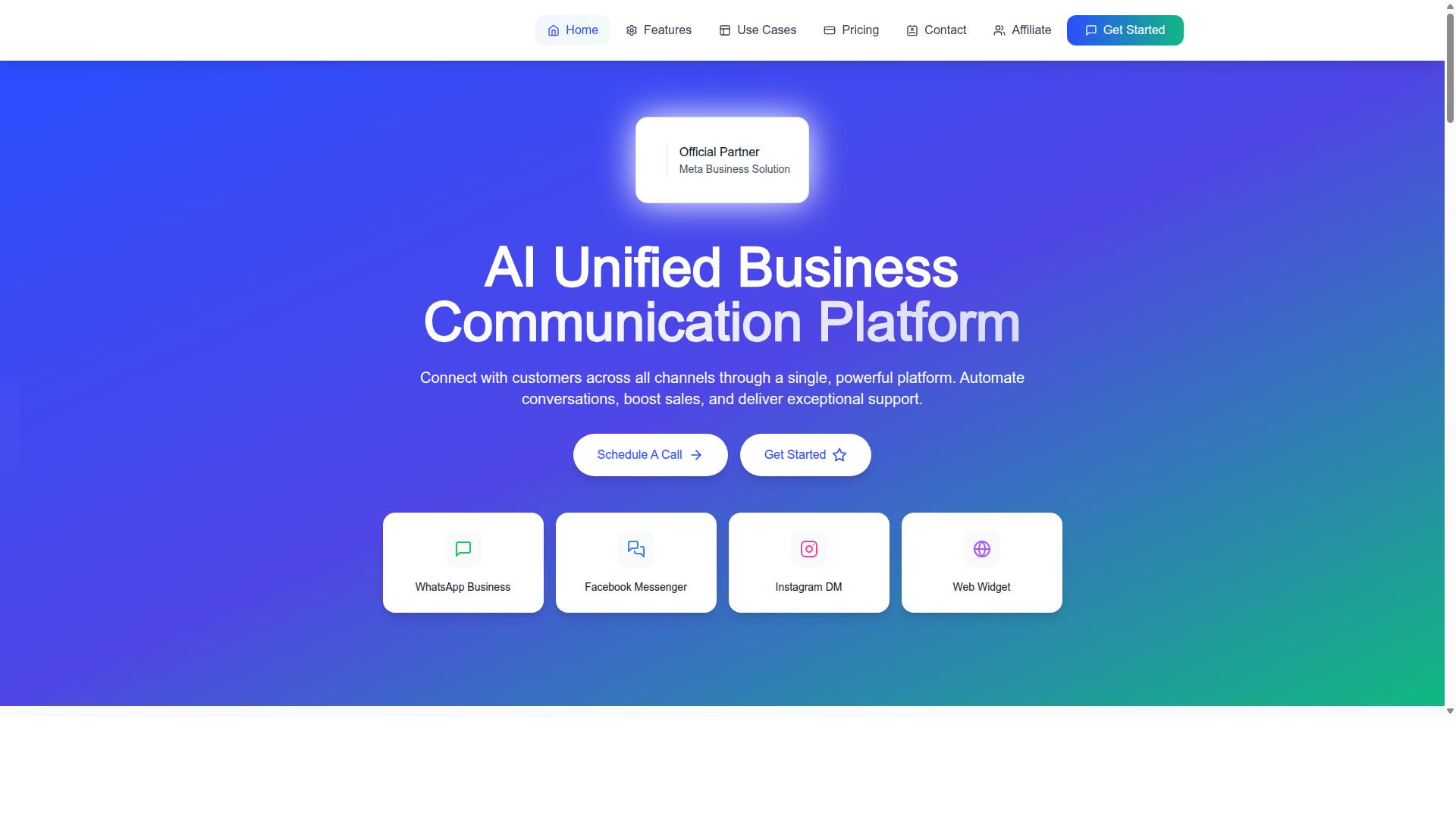
Com.bot exemplifies how a drag-and-drop visual builder can unify WhatsApp automation, team collaboration, and payments into a single platform. It is an AI Unified Business Communication Platform that connects customers across WhatsApp Business, Facebook Messenger, Instagram DM, and Web Widget.
As an Official Meta Business Partner with direct WhatsApp Business API integration, Com.bot removes the need to stitch together separate tools for chatbot development, inbox management, and payment collection. That matters when you are comparing platforms on ease of use and long-term operational fit.
The two sections below break down what the platform offers: its core feature set and its plan options.
Visual Bot Builder, Unified Inbox, and Native Payments
Com.bot's core offering combines a drag-and-drop visual bot builder with a unified team inbox and native payment capabilities for WhatsApp transactions. The no-code builder lets teams assemble chatbots and workflow automation without writing code, which shortens the path from idea to a live conversational flow.
The unified inbox consolidates WhatsApp, Facebook, Instagram, and web chat into one place, so agents handle every conversation from a single screen. This omnichannel messaging setup supports faster response times and more streamlined operations across support and sales teams.
Native payments allow businesses to collect payment inside the chat, turning conversations into conversational commerce without redirecting customers elsewhere. Combined with multi-channel support, these features help teams move quickly and capture more sales opportunities.
- Drag-and-drop bot builder for no-code chatbot development
- Unified Team Inbox across WhatsApp, Facebook, Instagram, and Web Widget
- Native Payments for in-chat transactions
- Multi-channel support with 100K+ bots created and 25M+ messages processed daily
Plan Options and Global Availability
Com.bot offers tiered subscription plans and add-ons to accommodate businesses of varying sizes and needs, with global availability across 50+ countries. Pricing is quoted in USD, and WhatsApp messaging is billed at actual Meta rates with no markup.
| Plan | Price | Best For |
|---|---|---|
| Silver Plan | $149 per quarter | Smaller teams starting out |
| Gold Plan | $349 per quarter (Recommended) | Growing businesses |
| Platinum V1 | $2500 per quarter | Larger, higher-volume operations |
Add-ons cost $10 per month for each additional team member, social channel, or external actions (per 5000). Dedicated support is also available: WABA, CRM, and Inbox support at $49 per hour, and Ecommerce, Bots, and Automations support at $99 per hour.
The Gold Plan is the recommended choice for growing businesses that need more capacity without jumping to the top tier. When choosing, assess your message volume and team size first, then match the plan and add-ons to that baseline rather than overbuying upfront.
Testing and Onboarding: Questions to Ask Before You Commit
Before committing to a WhatsApp Business API platform, thorough testing and a clear onboarding plan are essential to ensure long-term success. A polished drag-and-drop interface can still hide weak support, slow implementation, or limited data control. The questions below help separate platforms that fit your workflow from those that only look good in a demo.
Start with access. Is there a free trial or sandbox environment? A sandbox lets you test the no-code builder with real message templates, interactive messages, and webhook configuration before you pay. Ask how long the trial runs and whether it includes live API integration or only a visual preview.
Then cover support and timelines. Ask what onboarding support is included, whether it is live or documentation only, and how long implementation typically takes for a setup like yours. Confirm whether training resources exist, such as guides or walkthroughs, and whether you can export your data, flows, and contacts if you leave. Data portability protects your chatbot development work.
Test the drag-and-drop editor with actual scenarios: a welcome flow, an order update, a handoff to helpdesk software. A node-based editor that feels simple in a demo may slow down once you build multi-step flows.
Com.bot offers an affiliate program and has policies covering cancellation, privacy, and terms of service. Reach the team at Head Office 501, Trinity Orion, Vesu Main Road, Surat - 395010, IN; Phone/WhatsApp +91 080 6987 1810; Email [email protected]; Business Hours Monday-Friday 9 AM-6 PM IST; WhatsApp Support available.
Recommended Resources: